First Winter Market at Museum a Winner!

We had a great turnout for the first indoor Olney Farmers and Artists Market of 2013, inside the Sandy Spring Museum.  Although there was not enough room for all of our usual vendors, many were there (and others will be there in the coming weeks).   And so were the other amenities: music, demos, kid’s activities, cafe seating.  And: indoor plumbing!

The Dr. Bird Room (the big, octagonal room) held the food vendors, cafe seating, a wine and chocolate tasting, and acoustic music.

The Winery at Olney teamed up with Steven Howard Chocolates to present a wine and chocolate tasting.  Two of my favorite tastes at once!


Our farmers were lined up in the Produce Hall, except for Homestead Farm, which was set up outside the Museum.


The Exhibit Hall and Quilt Room each held artists.  The kid’s activities were in a room right off the Quilt Room.


Nancy MacBride of Falcon Ridge Farm was selling her knit scarves.  She has promised to lead a knitting workshop on February 24th.  We’re off to a great start!

Posted in Eating, Events | Tagged , , , , | Leave a comment

FOOD Exhibit Part 2: Miss El Chico and Mrs. Mondavi

Just as my favorite part of the media event for the Julia’s Kitchen re-opening back in August was meeting Julia’s niece, Philadelphia Cousins, the best thing about this exhibit’s event was meeting and chatting with several of the object donors.

Two members of the Cuellar family, John Cuellar and Carmen Cuellar Summers, were there.  They are  descendants of the founders of the El Chico chain of Tex-Mex restaurants, and were glad to tell me all about the wonderful sequin-spangled dress on display.  Worn by “Miss El Chico” for food demonstrations, promotions, parades, and the Texas State fair, it has traditional embroidery as well as the shiny embellishments.  It’s an example of a China Poblana-style native festival dress from Puebla, made about 1960.

Margrit Biever Mondavi was there to regale me with stories of her life helping to build Robert Mondavi Winery into the one of premier establishments in Napa Valley.  She told me that the reason there are palm trees in Southern California is that, during Prohibition, they were a sign that wine could be bought underneath!

She came from Switzerland in the 1960’s as a young girl and got her start in the wine industry giving tours for Charles Krug.  Her husband Robert was determined to develop California wines into a force to challenge the best of Europe, starting with the fume blanc.  In his hands, it became a crisp, dry white meant to go well with food.

As the winery became successful, Margrit developed the Summer Music Festival.  Although they were not advertised, the concerts always sold out.  Other concert series followed.  Then there was the Great Chefs Cooking School.  The Mondavis built an art collection, travelled, ate, drank and hobnobbed with chefs and artists the world over, all the while building the reputation of California wine.  With the help of Janet Fletcher, she has documented it all in a lovely book.

Margrit Mondavi’s Sketchbook is a beautifully produced memoir of a life lived to its fullest.  Illustrated with photographs and her own watercolors, it presents a picture of her appreciation of food, wine, friendship, and family.  In her own words and in short ” reminiscences” by such luminaries as Wayne Thiebaud and Jean-Georges Vongerichten, as well as family members and wine industry colleagues, it presents a picture of a life well-lived, with (lagniappe!) recipes.  I look forward to cooking her Braised Rabbit in Wine Sauce, and Mont Blanc with Strawberries for dessert!

Posted in Cookbook Review, Eating, Events, Food Book Review | Tagged , , , , , , , , , , | Leave a comment

You Know You’re Old When…

(and this is NOT a joke!) when you see the stuff of your childhood behind glass at the Smithsonian National Museum of American History FOOD Exhibit, for which Julia Child’s kitchen is now the centerpiece.  Granted, it is subtitled “Transforming the American Table 1950-2000,” so I should have been prepared, but still –  a Swanson’s TV dinner tray? A Corning Ware casserole? Tiki cups?  Aluminum tumblers? All could have come straight from my mother’s house.

Worse yet, Stalking the Wild Asparagus, Moosewood Cookbook, and the Time-Life Foods of the World series.  Bought new, these are all still in my collection! And a fondue pot, of which I received three as wedding presents.  I could go on, but you get the idea.

The exhibit traces the evolution of the American palate from the postwar reliance on convenience food and bland commercial products to the threshold of our present happy state of eclectic experiment.    It brought back memories of my childhood, and not all in a good way – my mother totally bought in to the “cooking is so hard, use our instant products and canned vegetables” line.  The section titled “New and Improved” explored the forces behind her choices: the growth of agribusiness, manufactured foods, supermarkets and their distribution systems, microwave cooking (including a microwave oven from 1955 the size of a washing machine), and availability of cheap junk food.  One of the stranger curatorial choices: showcasing a selection of plastic coffee cup lids.

I asked Cory Bernat, the curator of the plastic lids, where they came from.  She assured me that there are “collectors for everything,” including the lids and Weber kettles, like the cherry-red kettle in the exhibit.  I believe her.


Another section, “Resetting the Table,” explores sociological forces, including the influence of immigration, the counterculture, and the “good food” movement (including Alice Waters’ continued influence), which will – if we’re lucky –  carry our country’s food evolution into the future.

The third major section covers the rise of the American wine industry, with a major emphasis on California.  “Wine for the Table” features, among the array of winemaker’s tools and other artifacts, the two bottles of California wine that won the 1976 Paris Tasting, triumphing over all French entries and announcing the arrival of serious American competition for the European wine industry.  The rest, as they say in the museum trade, is history.

Posted in Cooking, Eating, Events | Tagged , , , , , , , , | Leave a comment

A Locavore In Baltimore – Woodberry Kitchen and Future Harvest-CASA’s Partnership

Future Harvest CASA is an admirable organization dedicated to sustainable farming in the Chesapeake region.  They have a yearly conference that’s a great opportunity to learn about and network with farmers, restaurateurs, and allied folks concerned with the health of our food-production ecosystem here in the mid-Atlantic.  Although I was aware of their other programs, I hadn’t participated in many of them; but a few weeks ago, I got a notice of an event that I couldn’t resist.

It was billed as a Field Day and organized primarily for the benefit of members of their Beginner Farmer Training Program.  We snagged two of the 10 spaces available for non-farmers.  Here is what they promised would happen:

Noted farm-to-table chef/restaurateur Spike Gjerde will take us behind the scenes at Woodberry Kitchen. At Woodberry Kitchen, not only do fresh ingredients star on each day’s menu, the kitchen excels at preserving seasonal ingredients in-house for future use. Chef Gjerde will talk about what chefs need from local farmers to make sourcing relationships work and show us what happens to our lovingly raised farm products once we leave them at the restaurant door.  Lite fare included.

And we were not disappointed.  We gathered in the restaurant and enjoyed freshly-made iced tea while we waited for the group to gather.  Then we toured the extensive kitchens, storage and prep areas while learning how Chef Spike utilizes the locally-sourced ingredients arriving at his establishment.

We started in this prep room, where Spike explained his philosophy of establishing partnerships with producers and butchering whole animals in the restaurant.  He has a special interest in Mid-Atlantic heirloom vegetables, and partners with at least 70 farmers in the Chesapeake region.  We were salivating over the plank full of tasty morsels, but were led away from it to the other areas of the kitchens.

George, the butcher, explained nose-to-tail butchery.  His crew breaks down large cuts – cooks some, cures others.  The aging room is full of house-cured cold cuts.


We moved on to the baking area, where we met Isaiah.  He makes bread and other baked goods for the restaurant and the recently-opened cafe (Artifact Coffee).   Also, house-made spelt noodles.


Spike does not have a candlestick-maker (yet!) but he does have a large pantry with shelves full of preserved fruit and vegetables.  He explained that a restaurant which is committed to locavor-ism in our climate needs to solve a problem: how to find local produce in the winter?  Woodberry Kitchen is addressing this by putting food by.

We passed other areas, including fresh fruit and vegetable storage, a wine cooler and a storeroom piled with sacks of flour and grain.

We returned to the dining room we had started from, to find that the goody-laden plank had been magically transported to the middle of our table.  House-cured meats, house-made crackers, local cheeses, fresh and pickled vegetables, dips, and deviled eggs, supplemented by flatbreads from the wood-fired oven and iced tea, were sampled while we continued the discussion of supply and utilization of the most excellent products of our region.

Woodberry Kitchen is an example of how a secure source can encourage small farmers to succeed in our era of agribusiness.  Here’s to its continued prosperity!

Posted in Eating, Events | Tagged , , , | Leave a comment

Foodie Adventures At The Inner Harbor

Recently, I attended a non-food-related conference at the Pier 5 Hotel in Baltimore.  This is a small hotel built on one of the piers at the Inner Harbor, and I was surprised to learn that it has conference facilities, let alone a catering department that turns out better-than-average food for those conferences.

The highlight, though, was the “crabby hour” it dishes up for both conference attendees and regular hotel guests.  Every weekday at five o’clock, a counter in the lobby is set with burners and chafing dishes, and a chef holds forth with a demo dish of crabby goodness, together with  complimentary wine.  Old Bay crepes with crab filling and creamed crab dip were featured during my stay.

Josh is billed as a “Harbor Magic Specialist.”  He is not only a chef, but an evangelist for good works that the hotel’s management participates in, such as partnering with the Chesapeake Bay Foundation in their oyster re-seeding program.  They aspire to be a green company, and they want their guests to know it!

Showmanship is a big part of this shebang, as is audience participation.  You can cook your own crepe, and you also get to wear the hat.  A surprising number of jaded conferees agreed to it.


I had a free hour during the conference, so I walked over to Harborplace and the McCormick store (McCormick World of Flavors) I had spotted on the way to the hotel.  Those of us who have lived in Maryland for a while remember when McCormick was a major presence at the harbor.  Their headquarters building was torn down some years ago now and replaced by a hotel, but I still remember how the smell of spices would waft out on the wind and scent the Inner Harbor.  To get that experience now, you have to truck out to Hunt Valley.

But now McCormick is back – and how!  The store is enormous, and contains not just the herbs, spices and extracts you would expect to find at any supermarket, but products from McCormick subsidiaries specializing in Latino condiments, French baking mixes and decors, and Canadian honey; package sizes from single-serving blister packs to gallon industrial jugs; tea, both black and herbal; and experimental products (“some available only here,” according to Nijah, who helpfully answered all my questions), like fruit preserves and jellies; about a dozen varieties of chocolate bars; candles; tapenades, salsa, olive oil, vinegar, salt, not to mention wonderful old-style mixing bowls and other kitchen equipment; and Old Bay.  Not just the original but different flavors of Old Bay.  I sprung for some “with blackened seasoning.”  Paul Prudhomme would probably frown, but it smells amazing.

Oh, and there are interactive experiences (Find Your Flavor Profile), and static exhibits of historic packages, teapots, advertisements, cookbooks, and text detailing the history of the company from its founding by Willoughby McCormick in 1889 to the present.  And cooking demos.  And helpful recipe cards, and helpful staff.  And custom gift baskets; and shipping, back to where you can’t get all this wonderful stuff, for you tourists.  Am I gloating that I live in the neighborhood?

This is their first retail outlet, more are planned if it does well.  The scent of cinnamon wafts through the store, much like that of mixed spices used to just outside the doors.  Excuse me while I have an attack of nostalgia.

Oh, one more thing: at the end of the block, there is a parking garage draped to look like  a huge tin of Old Bay.


Posted in Cooking, Eating | Tagged , , , , , , | Leave a comment

The Cardoon Adventure

Last Sunday, we went down to the Takoma Park Farmer’s Market.  One of the farmers was selling cardoons.  They were bundles of stalks two feet long, and they looked pretty formidable, like great big, overgrown celery.

Cardoons are cousins to artichokes, but the stalks are cooked and eaten instead of the flower buds.  They have to be boiled a long time before they are tender and lose their bitterness.

Now, I had seen cardoons for sale around here only once before, in the DuPont Circle Farmer’s Market.  I had bought them and cooked them, but that farmer had not blanched them, and they were hopelessly tough and bitter.  Not a good start; but these folks assured me that they had blanched them properly (which is to say they hilled up the dirt around them as they grew, to deprive the stalks of daylight and turn them pale).

And they did, indeed, look properly pale, so I bought a bundle and brought them home.   They barely fit in the refrigerator.


Research indicated that they should be boiled until tender.  Most recipes (in the new edition of Larousse and my go-to Italian cookbook, The Silver Spoon, were heavily into calorie-filled oil, cheese, or cream-based recommendations, but I found an exception to the rule in Silver Spoon: Cardoon Salad (Cardi In Insalata), in which the boiled cardoons are dressed with lemon juice, olive oil, chopped hard-boiled eggs, parsley and browned bread crumbs.  I decided to add some leftover cooked turkey to make it a supper.

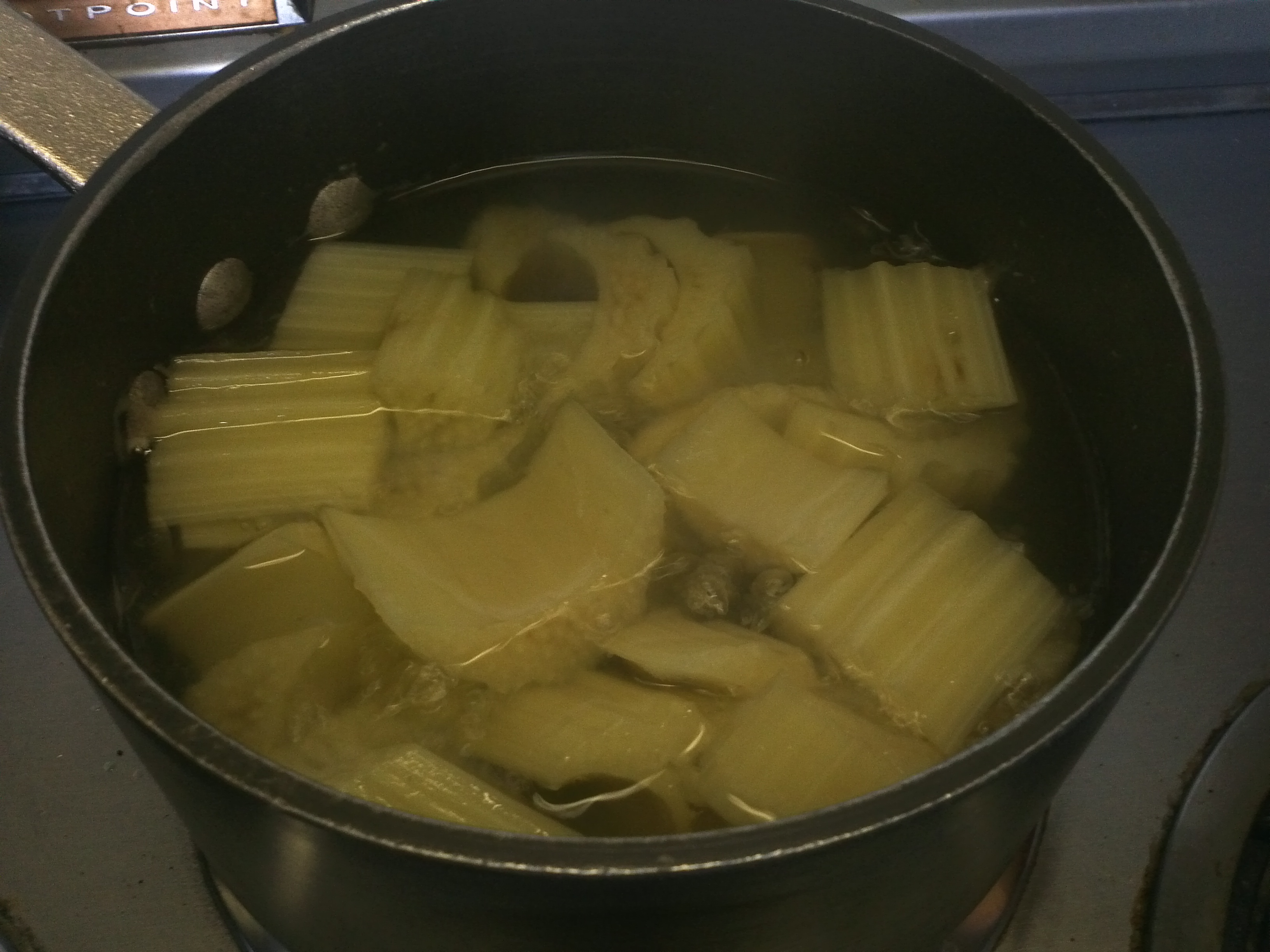
First, though, I had to cut those monster stalks up, strip the strings from the outer sides and the little “thorns” from the edges, clean them and cut them into 2-inch pieces.  And part them from their wildlife.  It turned out not to be a job for the squeamish.


The books were silent on the question of cardoon leaf edibility.  They resembled celery stalks so closely that I thought I would include the tufts of inner-stalk leaves in the pot.  This, it turns out, was a false cognate.  Those leaves were so bitter they could be used to strip paint!  I had to fish them all out.

When boiled for two hours, they turned a lighter shade of pale and became tender.  They made a good dish of warm salad, and two large containers of leftovers.  I have since added them to a frittata, to pasta with tomato sauce and cheese, and there are still some left.  If the first definition of eternity is two people and a canned ham, two people and a cardoon plant is a good second!

Posted in Cooking, Eating | Tagged , , | Leave a comment

Eating Poland Part 2: Eating Out

Traveling for business often does not allow much time for sightseeing.  The day is taken up by meetings, so eating dinner out is sometimes the greatest exposure to the local culture my colleagues and I can manage.   On this trip, we had several memorable evening meals.

I found the food in the restaurants we visited to be meat- and starch-heavy, with some dishes almost always on the menu: for appetizers, a variety of dumplings, marinated vegetable salads, fried cheese, and sausage; a lot of pork, less fish and chicken, with beef dishes always double the price of any other meat; beer plentiful, wine mostly good but not great (but then, we didn’t order really expensive wine.  Most of my colleagues appreciated the excellent and cheap beer).

As for me, I discovered to my delight that flavored vodka is widely available and rewards a spirit of curiosity.  One restaurant we patronized, Starka, boasted of their homemade vodka flavors.  We decided to hold them to their word.

Here is the complete list of vodka flavors I tried on this trip: Hazelnut, Hot Pepper, Rowan Berry, Ginger, Apricot, Honey-and-Herbs, Cherry, Pear, Walnut, Rosemary, Cinnamon, Raspberry, and Honey.  With the exception of Raspberry, which was far too sweet, they were all good.  Hazelnut, Rowan Berry, and Honey-and-Herbs were outstanding.

Another dinner, at C.K. Browar, a cavernous brewpub under the Old City of Krakow, was remarkable for the unfiltered beer served in tubes.  A table can order a 3.5  or 5  liter tube filled with unpasteurized beer straight out of the brewing tanks.  I had some too.  It was not bad for beer.

I got pork ribs, which came with two side dishes.  These arrived as two bowls of very good creamed spinach and beets (described as “fried” on the menu, they were shredded and sautéed.)  Together with my appetizer of fried goat cheese with bacon, cranberry sauce and horseradish “mousse,” which I split with a fellow diner, it was far more than I could finish.

And if I thought that that meal was over the top, I hadn’t seen nothin’ yet.  Our Polish hosts sponsored a dinner the next night which was held at Morskie Oko, a restaurant which boasts on its business card of having “live folk Polish music” as well as “delicious Polish regional cuisine.”  We were treated to a sumptuous meal served family-style, as well as a show of musicians, singers, and dancers in colorful folk costumes – but that’s another post!

Posted in Eating | Tagged , , | Leave a comment

Natural Products Expo East, Part 2: Alice Waters, Blue Buddha, Made In Montana

Alice Waters gave the keynote address at the Natural Products Expo East.  She is an inspirational speaker, and the audience was there to be inspired!

The young people in the chef’s whites are students at Stratford University’s culinary school.  They, along with the rest of us, listened raptly as Ms. Waters spoke of the threat posed by “the fast-food paradigm that surrounds us all.”


She went on to say that the fast-food culture values efficiency, availability and cheapness over the more human and humane virtues of ripeness, beauty, patience, and community – “things that make our lives meaningful.”  The cost of cheap food will come back to haunt us through effects on the environment or individual health.

Governments can muddy the issue by refusing to define standards, or having poor regulation of terms such as “sustainable” and “grass-fed.”  The EU is misusing standards to remove uniqueness from traditional, regional products.


She founded Chez Panisse, her seminal restaurant in Berkeley, in an attempt to capture the way of life she was exposed to in France, with two-hour lunches in which entire families participated.  Other values were incremental and initiated by her employees, such as the pastry chef who saved and reused every scrap.  With her current passions, the Edible Schoolyard Project and the Delicious Revolution, she hopes to see every school become the center of a network of suppliers, composters, and healthy food proponents.  Schools can become economic engines for communities, and teach children to embrace human values.

She concluded with a call to arms:  “We’re still the counter culture!  Don’t be co-opted!  Don’t compromise with the fast-food nation!”  Everyone in the audience heartily agreed.

Several of the products at the Expo seemed to epitomize Ms. Waters’ philosophy.  The Montana pavilion highlighted their grain products, including farro, an ancient European grain being organically raised on the Great Plains by the Timeless Natural Food company.  When I mentioned my interest in this newly-popular ingredient, David Oien gave me a package to try.  I will be comparing it to the Italian product I received from the importer Italian Products USA at the Fancy Food Show. (Click on the “farro” tag to find that article.)

Many  new products were being touted at the show.  One line being launched was particularly intriguing.  Blue Buddha herbal teas were available in four flavors, each promising aspects of enlightenment for those who imbibe.  I’m not sure I attained the next level of consciousness after trying them, but I did heartily approve of the flavor profiles of the teas on offer for tasting: fruity, not too sweet, and very adequately thirst-quenching.  I think the “Hibiscus Raspberry Revitalizing” flavor was my favorite.

And if drinking it improves my health and/or relationship to the universe, so much the better!

Posted in Eating, Events | Tagged , , , , | Leave a comment

Eating Poland Part 1: The Plac Nowy

I spent a week in what must be the best place in Europe for eating cheaply but well.  Krakow, Poland, is a city full of genuine Medieval charm (not bombed in WWII) and genuine eating bargains.  I had several lunches and very good dinners with drinks, and never spent more than fifteen dollars for a meal.

Tuesday’s lunch, for instance, consisted of a “full Wypas” at the Plac Nowy market.  I walked there at noon on a dreary, rainy day and saw a sparsely populated market square with a few stalls selling vegetables and second-hand goods, surrounding a round brick building with inside stalls for meat sellers, none of them open.  I was about to mark it down as a wasted trip when I noticed that the market building was actually a central round structure with another, freestanding ring-shaped building encircling it; and this outer ring housed sellers of hot food.  Lunch!

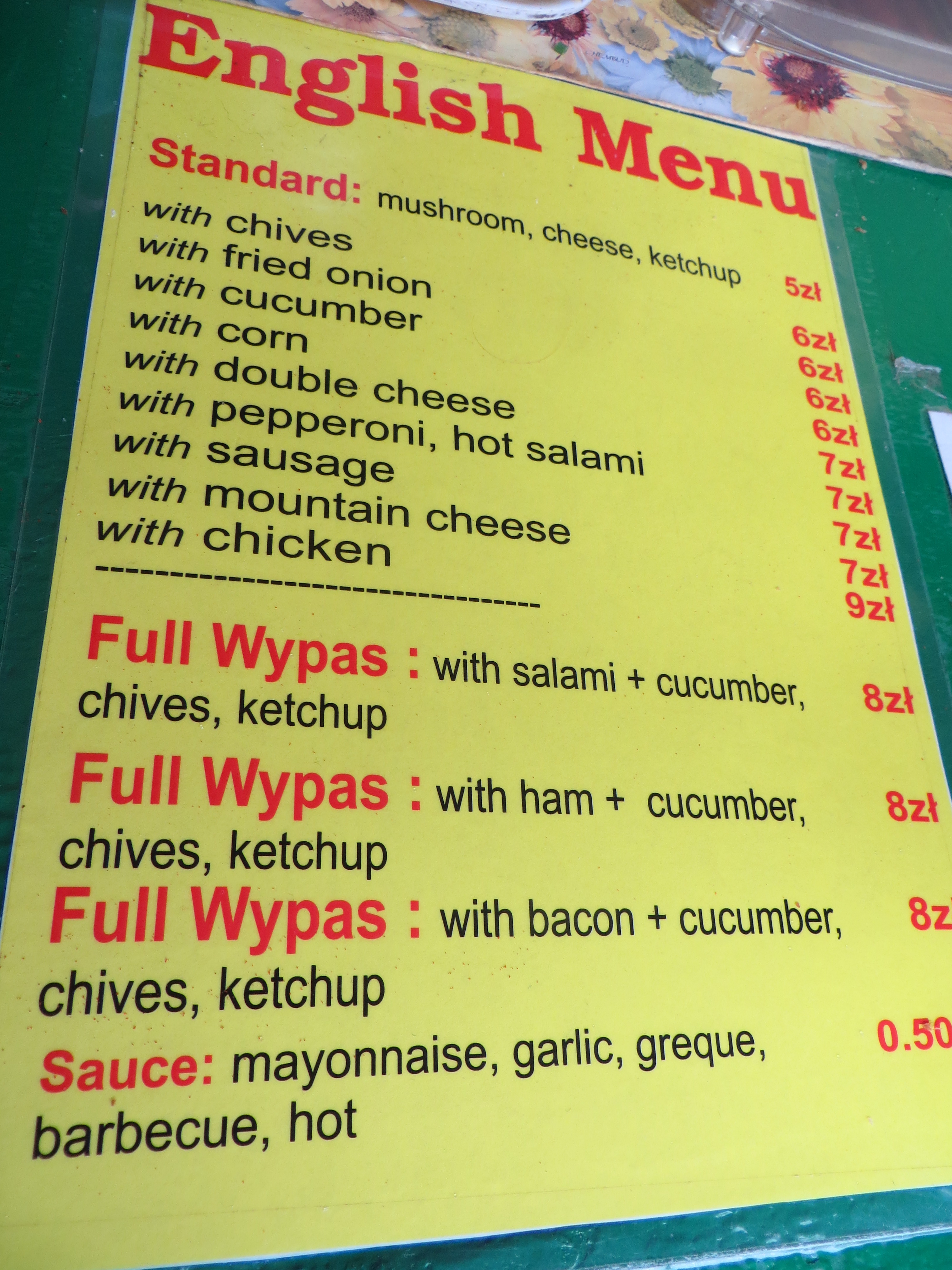
I had to walk all round the ring before I mustered the nerve to order.  I confess to finding a placard labeled “English Menu” heartening.  I could tell it was a pretty direct translation from the Polish, and the prices were not raised for the tourists!

After waiting about 3 minutes, I was presented with a construction about as long as my arm.  It was warm baguette-like loaf, toasted, covered with mushrooms and melted cheese, ham, ketchup, pickles, and chives in a cardboard sleeve, for which I paid 8 zlotys.  I completed the meal with a can of Pepsi decorated with a picture of Elvis Presley (Elvis Pepsi!)  for 1 zloty more.  That was a grand total of three dollars.


Cheap, yes, but was it good?  Also yes.  Warm, crispy on the outside, tender in the crumb, with savory toppings, it was so big I could barely finish it – although my new best friends, the pigeons, helped me out there.

During my week in Krakow, I learned that the Plac Nowy was the main market for Kazimierz, the old Jewish Quarter, before the Holocaust.  Now, its business increases towards the end of the week (and depending on the weather).  I expect it would be more populated on the weekend, but I only saw it on lunch times and on Friday afternoon.

It was much livelier in the better weather.  On sunny Thursday, I went back for another full Wypas from another window in the wall.  This time I got a chicken with garlic sauce, and it was even better than the first one.  There were more second-hand stalls open, and I did some shopping; then I had to go back to my meeting.

On Friday, a colleague and I shopped for provisions to cook dinner for some of our fellow committee members.  The market was lively, the outer stalls were full, but alas! the meat stalls had closed before we got there.  We were directed to a butcher shop down the street, but that’s another post!


Posted in Eating | Tagged , , , , | Leave a comment

Carla’s Encore and The Winery’s Debut

One of our favorite demo chefs, Carla Hall, came out to the Olney Farmers and Artists Market last Sunday.  She did not disappoint the biggest audience of the season (by my estimate).  She cooked a mess of country-style greens and served them with cornbread.  Both recipes can be found in her new cookbook Cooking With Love, which will be published on November 6.

Before she started cooking, she took a tour of the produce vendors at the Market and came back with hot peppers from Mike at Homestead Farm, assorted veggies from Pleitez, Penn Farm, Westmoreland and Valle, and a bunch of rutabaga greens (!) from Joan Riser at  AvianMead.

She chopped them all up and made a pot of greens on the spot, to supplement the already-prepped batch she brought with – proving that you can use any greens for this recipe, as long as you cook each until tender.  They were served with cornbread to soak up the pot likker,  and everyone agreed they were delicious, even those who don’t generally like greens.

The recipe for the greens is posted on the OFAM website, but for the cornbread you’ll have to buy her book, publisher’s orders!

Also last Sunday, we welcomed The Winery At Olney to the Market.  They have just opened in the Fair Hill shopping center (see Bending An Elbow In Olney for a description of their operation).

Posted in Cooking, Events | Tagged , , , | Leave a comment